English| EUR
Suggested for you
More currencies
Choose a language
The Mojave looks empty until something moves. Visitors driving between Baker and the Providence Mountains often wonder which large mammals share the creosote flats with them. This page sets out what the record shows about bears here, which ranges nearby do hold them, and what to expect on the ground instead.
Quick answer
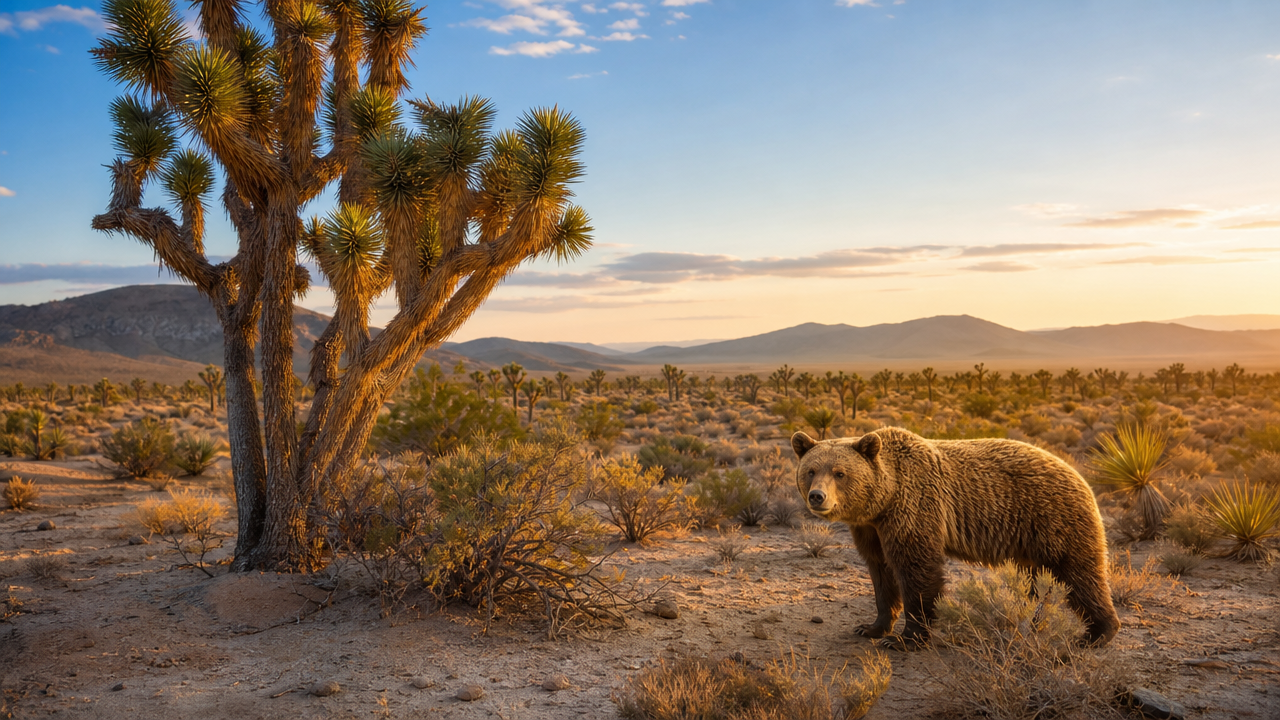
No — there is no resident bear population in the Mojave Desert, and the California grizzly has been extinct since the 1920s. Black bears live in the wetter mountains ringing the basin, including the San Bernardino and Spring Mountains, and lone young males occasionally wander close. Sightings inside Mojave National Preserve remain exceptional rather than expected.
California's state flag carries an animal that vanished from the state a century ago. The last confirmed California grizzly was killed in 1922; the last credible sighting came in 1924. That extinction frames the question "are there bears in the mojave desert", typed most often by drivers who have just watched the Providence Mountains rise out of the creosote flats. The answer turns on water and food, not on wilderness. A landscape can look wild, hold mountain lions and bighorn sheep, and still offer a bear nothing worth staying for. Black bears are edge dwellers here. They hold the wetter, higher ranges that ring the basin: the San Bernardino Mountains to the southwest, the Spring Mountains above Las Vegas, the southern Sierra Nevada to the northwest. Those slopes carry oak mast, manzanita berries, snowmelt creeks and deep conifer shade. Mojave National Preserve carries none of that at scale. Clark Mountain reaches 7,929 feet and shelters a relict grove of white fir, a survivor from a cooler epoch — but it is an island of a few acres, cut off by forty miles of Joshua tree woodland and open desert. Cima Dome, the Mid Hills and the New York Mountains follow the same pattern: enough elevation for pinyon and juniper, nowhere near enough forage for a resident bear. Dispersing young males do occasionally cross open country, and wildlife agencies in Nevada and California log the odd wanderer near the desert margins. These are transits, not populations. The animals visitors actually meet are desert tortoises crossing sand at first light, kit foxes near Kelso Dunes, coyotes on the Kelbaker Road shoulder, and bighorn sheep on the ridgelines above Hole-in-the-Wall. Reported desert bear sightings in this basin almost always turn out to be black-coated dogs, feral burros or a trick of heat shimmer on the playa. The practical takeaway is a reordering of priorities. Bear canisters and food hangs belong in the Sierra; water, shade and an early start belong here. Guided Mojave Desert wildlife tours through the preserve's washes and cinder cones read the ground for tortoise burrows and bighorn tracks, not bear sign. Which is why the recurring search are there bears in the mojave desert tends to resolve into a more useful question: what does this desert actually hold, and when is the light right to see it.
“A landscape can look wild, hold mountain lions and bighorn sheep, and still offer a bear nothing worth staying for.”
The best time to visit the Mojave Desert is during the early morning hours, specifically the 06:00–10:00 arrival window. This period allows visitors to engage in desert exploration while temperatures remain mild before the onset of peak afternoon heat.
Mild temperatures, 70°F–85°F
Spring offers pleasant conditions for outdoor activity before summer highs.
Cooler temperatures, 65°F–80°F
Autumn provides comfortable weather for desert excursions after the summer heat.
—
Arriving between 06:00 and 10:00 avoids the most intense heat of the day.
Verdict: For optimal conditions, plan your visit during the spring or fall and ensure your arrival occurs between 06:00 and 10:00.
The Mojave Desert is a remote region accessible primarily by private vehicle. The primary access point for visitor services is located at 2 Black Canyon Road, Essex, CA 92332.
Interstate 40 to Black Canyon Road
Kelbaker Road to Black Canyon Road
Plan your travel to reach the area during the recommended arrival window of 06:00–10:00. This ensures you avoid peak afternoon heat while navigating the desert's isolated road network.
Access to the Mojave National Preserve does not require an entrance fee. Visitors may enter the preserve at no cost.
Verdict: A typical adult pays 0 USD to enter the Mojave National Preserve, as there are no entrance fees or ticket tiers.
The Mojave National Preserve remains accessible to visitors 24 hours a day, seven days a week.
Everything you need to know about are there bears in the mojave desert
Black bears are not found in the Mojave Desert because the environment is too arid and lacks the necessary food sources and habitat. Most visitors find that sightings of desert tortoises, bighorn sheep, and coyotes are far more likely than encounters with apex predators. While you may wonder are there bears in the Mojave Desert, the reality is that the habitat is suited for heat-adapted species. To ensure a safe experience, you should plan your trip during the best arrival window of 06:00–10:00 to avoid extreme temperatures. As of 2026, there is an entrance fee of 0 USD for all visitors to the Mojave National Preserve. Because are there bears in the Mojave Desert is a common concern, it is helpful to know that tour operators prioritize routes in areas inhabited by desert-dwelling wildlife, not mountain or forest creatures. Please remember to pack plenty of water, high-SPF sunscreen, and protective clothing to stay comfortable during your exploration.